Reporting – Fiscal Artisans

October 21, 2021
zq-lee-Q6H4SwjsAdI-unsplash.jpg?fit=1200%2C800&ssl=1

Those of you who have been to my office, or perhaps seen the background on our Zoom chats, will know that I have a fish tank just behind my desk.

Freshwater Tropical Fish. They are relaxing to watch and provide a nice vista in the room.

Watching the freshwater mussel wander around the tank is fascinating!  (Who knew they moved around so much?)
Anyone who has kept an aquarium knows that regular maintenance is needed. Clean the tank, the filters, test and change a portion of the water. Feed the fish (of course!), re-vegetate or decorate the tank. And at times, deal with illnesses, or restock the tank.
A few weeks ago, after doing a water change in an evening, I came into the office the following morning to find a disaster had occurred. 
The oxygen pipe – which ‘bubbles’ Oxygen through the water in the tank – had come loose from its pump. 
 
The oxygen pipe became a water leak.
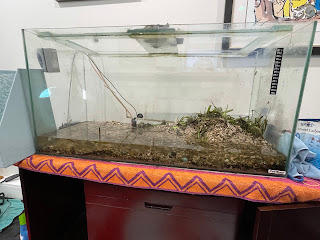


Instead of providing life, it was leaching it out of the tank.

And left 90 litres of water all over the floor, the carpets and the office floorboards. That was not something that could just be ‘sponged away’.
Some of the fish survived, barely breathing in the shallows under the ‘pipe’, but I also lost more than a few of them.
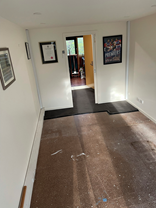


Thankfully, insurance helped deal with the carpet and floor damage (carpets removed, air dryers in the office for three days, running 24/7 to dry the floor.) And a small replacement tank used to keep a few fish alive while I ‘recovered’ – both mentally and organisationally. 


Over the next few days, the incident made me stop and think, OK, what is this telling me?
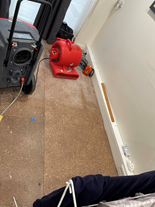
In terms of the aquarium, it was “Check everything is right and tight,” i.e., all the pipes are connected and in place.  Filters cleaned and functioning correctly. All systems checked and working properly. Are there other leaks or concerns that I have missed? 

Do I have the information in front of me, and am I regularly looking at it to take corrective action?Having had the carpets replaced (finally – despite lockdown restrictions) and ‘refurnishing’ the office – When you go back to a bare room, it gives you scope to relook at the whole set-up – It made me think – In the context of business, what is the lesson from this?


As I see it, it is very easy for us to get caught up in ‘doing the do’ and not looking at “what” we do and “how” we are doing it.
We focus on the job at hand, not the follow-up, and then move on to the next job. Have we been paid for past work? Who or what do we owe? What information do I need to supply – (to the taxman, the bank, the accountant, etc.). Do I really know how my business is going?
Did I check back with that client? Or follow up on that enquiry? Have I looked at my processes – are they efficient, or am I missing or taking more steps than I need to? Where am I at, and how easy is it for me to know how I am going?


Am I ‘making do’ until later instead of fixing things now? For some, the Lockdown period has been an opportunity to reexamine things and how they do them. For others, it may have pushed these actions into the background, so now, as we start to open up again, we find that the ‘pipes are loose’, or the wheels are off-kilter.  There are gaps in our processes that need fixing.From a business point of view, this means having an eye on the financial aspects of your business. Having the key data that you need to be aware of, to keep you on track.With The Xero accounting system, there is a lot of information that is relatively easy to access in terms of how your business is going, and what needs to be done. But for some, the Infomation is presented too much like ‘accountants speak’ – too dry, and not clear enough for a quick understanding.
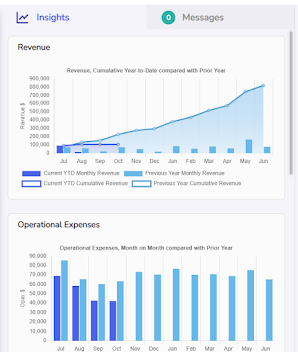
So, what if I could give you a system that looks at your data in Xero, and gives you simple summaries of information – like ‘how much do I need to pay next week? What is due to me from invoices outstanding? What is overdue? What is my profit for the month? How much ‘paperwork do I need to catch up on?

Packaged into easy, quick answers that look like tweets rather than another chapter of War and Peace?

Something that looks like this? And sent to you on your phone or tablet for easy access?


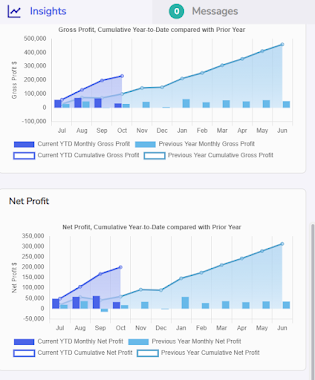
Or a web based dashboard that shows something like this:


As well as a rundown of items to be looked at. And an “Alexa/Siri” style ‘ask me’ facility to look over various items in the reports. Or to find out more information. And a portal to “ask me anything” as well. Would this be useful to you? Would it help to focus on particular areas that we need to discuss – and take action on? It is a web and app-based system called Aider, which I have been looking at as a ‘Dashboard’ system to help me look over client data. Many features have already been added, and more will come as they continue to develop the system. (Which I am involved in the review of currently) This system can also capture information from other sources – like your social media marketing, point of sale systems, banking, and calendar systems- to be a quick ‘one stop’ for your information. It can connect up to 16 apps, has lots of social media analytics, and provide easy-to-digest information for you 24/7. 


The idea, of course, is to focus on the key parameters. If you like, the ‘oxygen pipe’ allows your business to breathe and not leak cash, clients, activity, etc.

  1. What have I invoiced for the last week/month?
  2. What bills do I need to pay in the next week/month? What are my tax liabilities? DO I need to pay any super?
  3. What jobs need completing? What projects need to be started/completed/invoiced?
  4. Am I on track? Are my sales/expenses/cash at the bank at the level I expected for the year?
  5. Is my system helping me or hindering me from keeping my finger on the pulse? What can I do about it to improve?I believe that this system can help us get to these key elements quickly and easily – as well as helping us here to keep an eye on your accounts to see if we can help you with anything in your files.

I will be rolling this out with a number of our clients and look forward to discussing the details further with you as part of our work with you.  Give me a call, and let’s see how this system can help you keep your oxygen pipe stay secure, unblocked and flowing free!


As for my fish – They are housed in a new tank (as further checks and tests found more than one problem that I had to deal with!) and living happily again.


Even Jasper approves of the new facilities.
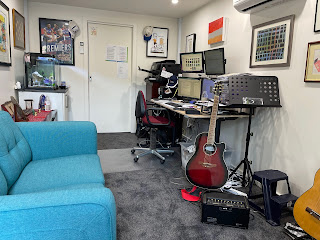


And the office set-up is better than before – ready to accommodate face-to-face appointments soon!


For more information on Aider, go to www.aider.ai, or call me to discuss.


And a great Youtube site on keeping fish that I can highly recommend is “Lazarus the Fish Boy” 


Easy to follow and a great watch! And yes, he is the son of one of our hugely talented clients!    

Let’s keep the Oxygen flowing and breathe new life into your business!


July 28, 2021

If your Business Feels like you are scaling Everest,

It’s Time to Go Beyond The Numbers.

You have done more in the last financial year than just survive, but it has been hard!

This is the time that we turn our attention to our year-end obligations – namely, preparing financial statements and preparing tax returns, and looking at how well (or otherwise) we have done for the year.

For many, the financial statements and tax returns that we prepare are a ‘historical document’. It is a look at the numbers ‘in the past’. But what it can be, is a roadmap to the future – the starting point to your next trek.

What do you have your sights set on for 2021/2022? How can we Go Beyond The Numbers to help you achieve it?

With another financial year over, and one which for so many will have been one of the hardest ever faced, it is beneficial to look at your current situation and reflecting on your successes, not just what has or has not happened.

For many, being in business is a bit like trying to climb Mount Everest.

It is tough!

The air is thin up there, and it seems like something many dream about, but few succeed at actually doing. And no matter how hard you try, you feel like it is all uphill, all the time. And if you fall, the crash will be hard, and deadly.

Let’s look at The Numbers

Many people know that Mt Everest is over 29,000 feet, or over 8,800 meters tall. To scale the mountain, people usually start at one of the two base camps, which are over 5,000 meters above sea level.

To many, it seems an insurmountable task.

But let’s look at this differently, and Go Beyond The Numbers

One of the things that I have been doing for a while is checking in regularly with my business coach. Michael has been a client, friend, confidant, and business coach for some time now. He has helped me look at many aspects of the business, my processes, and, more importantly, the values and ethics inherent within my organisation.

In one of our recent meetings, we looked at the last year or so and set the targets for the year ahead (his and mine). As part of this discussion, we acknowledged that we had done more than just ‘survive’ with what we have been doing over the last few years.

He described it as ‘being at Mt Everest base camp’, having got there under our own power.

Let’s unpack that and how this relates to what you do.

To get to base camp, there are a few options.


 You can fly in; 


You can drive in most of the way;


Or you can walk up to the base camp from sea level.


For many people, ‘just getting to base camp’ is a success. It means that they have gone from ‘zero’ – sea level, starting with nothing but their personal skills and knowledge – to scale a height few people achieve. They can stay there and ‘live’ quite successfully.

In business terms, it means you are running your own business, paying your way, covering your living expenses, and providing for yourself and your family, without having to ‘go back downhill’ and ‘work for wages’ (or get financial support from family or friends to survive). You have ‘got the combination right’, and you are not staying awake at night, wondering how the gas bill will be paid next week.

Having ‘walked up to base camp’, you have developed the strength, the skills, and the resilience to maintain your position at a high altitude. This is something that you need to both acknowledge and celebrate.

In some cases, people have ‘flown’ into base camp without acclimatising to the rarefied air. For most of these people, being at base camp is simply a ‘holiday’, and they cannot stay for very long.


It is much like their business ventures. The ‘fly-ins’ may have had a business purchased for them, or ‘inherited’ the ownership or a partnership arrangement. They get in, make some cash, and get out again. They have not developed their business skills through ability and have probably achieved their success as a result of other peoples ability to ‘get them there’.


That is not what you have done – you have ‘walked to base camp’ yourself. You may have had a group of people with you on the trek, but you got there using your efforts and ability. You walked your talk.

And you are not just surviving. You are thriving.

Think of it this way. The Everest base camp is over 5,000 meters above sea level. Everest is under 9,000 meters. So, if you have ‘achieved base camp’, you are more than halfway there already. Going further is not ‘starting from the bottom’ at all.


But what about scaling Everest? Isn’t that the goal? And how do I get there?

For some, yes, that is the goal, but it is not the ‘only’ goal.

When you get to base camp, it is not hard to look around and see that there are a wide range of mountains that can be climbed. You don’t have to choose ‘Everest’ and be done with it.

Your choice can be completely different to anyone else, or you can simply stay at base camp.


In a business context, that choice could be:

  •   Staying as is, managing and maintaining the business as it stands now, and managing it profitably without aiming for growth and expansion; “Keeping it ticking over and under control”; Perhaps achieving ‘the same result’ from less time, and less effort, and using the spare time for other chosen pursuits;
  •    Doing ‘more of the same’ duplicating the business or expanding the volume of work done (without expanding services, products etc.) “Same but bigger”;
  • Doing something new within the business; “Do we climb Everest, or K2?”
  • Using the profits from the business to build an investment portfolio, pay down debts, etc.; “Let’s go climb Mont Blanc in Europe instead”;
  • Learn new skills (personal or professional) that are unrelated to the business activity; “I’m done climbing. Let’s learn to fly instead.”
  • Or you can work with others and help them build their careers. “Having done it myself, I will show you how to climb”.

The choice is yours. But it is not a choice that means you need to ‘start again’, nor is it something that you need to do ‘alone’.

At base camp, to climb the heights, the first thing you need to do is:

Hire the Sherpas!


The Sherpas are the experienced, local climbers who ‘know the mountain’. They carry the loads needed to support you on your mission, and the local knowledge and guide and support you to achieve your goal of summiting the peak.

In a business context, the Sherpas come in several forms. It is the team of advisers – accountants, lawyers, bank and finance support, coaches and mentors who work with you.

It is also the ‘tools of the trade’ (in the business and finance context) that we use to help you keep on track – and helping to ensure you don’t fall down a crevasse. Tools such as Xero, and add ons like Dext (for data collection) and cashflow tools to keep you on top of your financial information are part of this. Your systems and processes, the way you do the things you do. Your marketing, social media, etc.

And the setup and structure that you ‘wrap’ around your business – with all the statutory and regulatory requirements in place to keep your trek in line.


This is what we mean by ‘Go Beyond The Numbers’. We look at the results, ask questions, and work with you to achieve your next peak. We ‘assemble the sherpas’ and come on the trek with you. We help you mount the summit, and take pride as you stake your claim on the peak.

 As an example, amongst the projects we are assisting clients with are the following:

   a)  Redevelopment of a regional property into a multi-unit dwelling, to retain one and use the others to build an investment portfolio;

   b)  Analysis of a business for sale (and undertake stocktakes and financial lending arrangements) to enable a client to expand their existing business beyond its current regional spread;

   c)  Convert a client business from ‘sole trader’ to a corporate structure, to both reduce total tax payable and expand their opportunities to grow their business;

   d)  Rent or buy? A client wants to look at whether to buy a small property to run their business out of, compared to renting a facility; And assist with the bank’s information needs for this.

   e)  Using property investment to reduce the tax a client pays this year and build an investment portfolio for retirement for their future. (or to ensure that their kids have somewhere they can move into in the future!)

   f)   Manage my portfolio! Would you please help me keep track of my share purchases, sales, dividends etc.? Even Crypto if you can (and, yes, we can)


In all of the above cases, we are working with our clients, helping them to ‘lead the trek’. We “assemble the Sherpas”, be it professional advisers (finance brokers, share traders, lawyers, etc.) and tools of the trade – software, data, reports etc., to help to make things happen. The only limitations (besides legal issues!) are your imagination and desire to make things happen.

So, having got to base camp and realising you are breathing the clean, thin air of achievement, where do you want to go next? 

What is your Everest?

Name your peak, and let’s go! We can make 2021/22 the time of your next achievement, plan, take action, and make it happen.

What is it going to be? Call or email me, and let’s talk about it.


Onwards and upwards – and let’s Go Beyond The Numbers.

Stuart Smith

Director (and Head Guide)

Fiscal Artisans