


Fiscal Artisans – Fiscal Artisans - Page 3

The Australian Taxation Office has just released its revised methods for working-from-home deductions for the 2022–23 tax year. The main change this year is that the ATO is now more focused on making sure people are actually working from home, and not just claiming the deduction without any evidence to back it up. So if you’re planning on making a claim for working from home this year, make sure you follow these new guidelines to avoid being caught out!
From the 2022–23 income year, the methods available to calculate working-from-home deductions are the:
- revised fixed rate method
- actual cost method.
While the actual cost method remains unchanged, the revised fixed rate method has been updated to better reflect contemporary working-from-home arrangements, making it easier to calculate expenses and avoid time-consuming apportionment calculations.
The revised fixed rate method:
- has increased from 52 cents to 67 cents per hour worked from home
- removes the requirement to have a dedicated home office space
- works out the claim for
- electricity and gas
- phone and internet usage
- computer consumables
- stationery
- allows taxpayers to separately claim the work-related portion of the decline in value of depreciating assets – such as office furniture and technology.
The revised fixed rate method can also be used by businesses that operate some or all of their business from home to claim home-based business expenses.
If you plan to use the revised fixed rate method for your 2022–23 tax return, you need to have:
- from 1 July 2022 to 28 February 2023 – a record which is representative of the hours you worked from home. (e.g. diary notations or a work record showing start and finish times for at least 1 month of work as a representative period of time for the year)
- from 1 March 2023 to 30 June 2023 – a record of the total number of hours you worked from home (such as a timesheet, roster or diary) as well as evidence you paid for each of the expenses you incurred that are covered by the fixed rate method (for example, a phone or electricity bill). You will also need records for any equipment you bought to work from home, like technology or furniture (which provides details of the supplier, cost, date acquired).
So this will mean that, for EVERY HOUR you want to claim work-from-home deductions using this method, you MUST have the time documented. While this may not be needed for your employer, it is necessary in order to be able to make a full and legitimate tax deduction at year-end.Your diary – paper or electronic – will become your best friend this year!
There are many apps that can be used for this, or even just a consistent notation on your diary of your start and finish times, recorded daily. But recorded it must be!
Working from home is becoming more common, so make sure you know what you can and can’t claim in order to get the best return on your investment. Contact Fiscal Artisans today for expert advice on how to maximise your deductions this financial year!

The Reserve Bank of Australia (RBA) has hiked the official cash rate by another 25 basis points to 2.60%. How will this rate hike impact your monthly mortgage repayments, and when will it happen?
At the beginning of May, the cash rate was just 0.10%. Today it increased for the sixth straight month to 2.60%.
It’s worth noting that the cash rate hasn’t been this high since July 2013, almost ten years ago.
The speed at which the increases have occurred has stressed many. And there are concerns about when it will stop. In reality, the Reserve Bank has probably been too slow, started acting too late, and may keep the rates going too long and then find themselves having to reduce rates sooner than planned.
The time to have started altering the cash rate was probably around July 2021, with small – 0.1 to 0.15% increases perhaps every 1 or 2 months – to cool the market before inflation took off. We don’t know whether there was economic or political pressure to avoid taking action, but we now have an overheated economy struggling to cope with the internal and external pressures evident daily in the news and the financial results personally, locally and globally.
We face further rate rises – perhaps taking the target cash rate to around 4% (a further 1.5% over the next few months) with maybe a pause for 3 – 4 months in 2023 before further ‘adjustments’ become necessary – that could go in either direction. The fact that this was a 25-point rise instead of another 50-point rise points to a possible easing by the RBA as they approach their desired ceiling. Inflation numbers will be key in the coming months – as will GDP and growth numbers. And the October Federal Budget could be a game changer. No pressure on the Treasurer at all!
RBA Governor Philip Lowe said that further increases were likely over the period ahead.
“The cash rate has been increased substantially in a short period of time. Reflecting this, the (RBA) board decided to increase the cash rate by 25 basis points this month as it assesses the outlook for inflation and economic growth in Australia,” said Governor Lowe.
How much extra will your mortgage be each month?
Unless you’re on a fixed-rate mortgage, the banks will likely follow the RBA’s lead and increase the interest rate on your variable home loan soon.
Let’s say you’re an owner-occupier with a 25-year loan of $500,000, paying principal and interest.
This month’s 25 basis point increase means your monthly repayments could increase by almost $75 monthly. That’s an extra $685 on your mortgage compared to May 1.
If you have a $750,000 loan, repayments will likely increase by about $110 monthly, up $1030 from May 1.
Meanwhile, a $1 million loan will increase almost $150 a month, up $1,380 from May 1.
So when exactly will this latest rate rise kick in?
When the RBA hikes the official cash rate, your bank will usually announce its own interest rate hike (and have its own notice period) for variable rates in the following days.
Let’s run through a quick example.
Assuming your monthly mortgage repayments are made on the 20th day of each month.
Let’s also assume you receive a notice from your lender this Friday (October 7) of their own subsequent rate increase, with a 30-day notice period.
By the time October 20 arrives, you won’t be paying higher repayments, as the full 30 days notice would not have passed.
When that 30-day notice finishes on November 6, the daily interest rate you’re charged will increase to the new amount.
That means when your monthly repayment on November 20 rolls around, you’d be charged at the new, higher rate (but calculated only from November 6).
By the time December 20 arrives, the monthly repayment amount you’re charged will fully reflect the new rate.
Some options we can help you explore include refinancing (which could include increasing the length of your loan to decrease monthly repayments), debt consolidation, or building up a bit of a buffer in an offset account ahead of more rate hikes.
If you’re worried about how you’ll meet your repayments in the months ahead, give us a call today. We can work with our associates and look at getting you the best deals on the market – even with your existing bank!
To start that process – and get a clear picture as to what your numbers look like – grab our fact finder at Fiscal Artisans Fact Finder

The Optus Hack – and what you
(and I) need to do with our business data!
It has become common knowledge that Optus has had its database breached.
And this has personal relevance to me, as I am an Optus mobile subscriber, with my business (mobile) number and those of my entire family impacted by the breach. I received the ‘generic’ email from Optus on Saturday (12:51 am. Nice they got it out at a time when it was likely to be buried under a plethora of spam emails), so the awareness of the issue came more from the press reports than the ‘genuine communication’ to its customers.
The key issues we need to look at here are:
- What was taken, and
- How did it happen?
- What does this mean in my situation?
- Stuart, is the data you hold on me safe?
It APPEARS (as Optus has not been crystal clear yet with this information) that their basic database information has been ‘taken’.
This includes:
Full customer name
Date of birth
Phone numbers
Email addresses
Account addresses
They claim that payment details (Bank and credit card numbers?) and passwords have not been taken – just the identification data. But that is bad enough.
Access may also have been obtained to the I.D. document details provided for the ‘100-point check’ each account holder needs to provide.
This would also mean access to items like:
Driver’s licence – state, number and expiry date;
Medicare card number and details; (They have reported that details of at least 35,000 current and expired medicare cards were accessed)
Passport details;
Other items used for verification could be your electricity account details, rates notice, etc.
The danger here is that these details are potentially enough to create a fraudulent I.D. or to assume someone’s identity to do things like:
- Change your bank account details, and get new cards issued to defraud you;
- Alter phone account details, and have your calls and mobile account redirected to someone else;
- Create new credit card accounts in your name that someone else controls (and leave you with a debt or bad credit record).
How did it happen?
While Optus has been claiming that it was a sophisticated attack, it seems the reality is that they left their backdoor unlocked and the lights on. The door might not have been wide open, but it was not far removed from that situation.
Many business systems are set up to ‘talk’ to each other using an interface or ‘API’ to do so.
To explain this, here is an explanation from The New Daily
In basic terms, APIs are ways for computers to pass code between each other (such as instructions). They are often used to enable services such as Google’s weather alerts, which make use of Bureau of Meteorology data.
They are supposed to be safe because companies usually have authentication rules attached to their APIs – but Optus allegedly did not.
“What we’ve seen is there was an API where you pass a phone number, and a phone number’s just … you just keep adding one, and you cover them all eventually,” Mr Hunt said.
“So why was there an API [without user] authentications? That could be a programming error.”
So the system that Optus was using did not have enough security built into it to stop a systematic ‘guessing’ of the key to access the data. It would be like if I could get hold of your ATM card and just keep guessing your PIN time after time without ever being locked out of the process. In time, with enough guesses, I will get access and can get all of your money. In this case, it only takes one correct ‘guess’, and access is obtained to potentially the whole database.
Data security is becoming increasingly important, and more attention needs to be given to this by everyone in business – even if you are a ‘business of one’ and freelancing or self-employed. Again, look at your contact details, the data you hold on your associates, customers, and finance arrangements and think about what data you need to hold – and how secure it is.
It is often considered that your database is one of your greatest assets in a business, and the reality is, that it is also potentially one of your greatest liabilities or risk factors, as you need to ensure you are ‘protecting’ your position and that of your customer base when you undertake your activities.
So, the potential danger here is that the data obtained won’t just impact activity with Optus. It can impact people in other areas.
Like in activity with the Tax Office.
I have been asked by a concerned client to check data on the Tax Agents portal, as it appears that some hackers are trying to change details with the ATO. This could result in tax refunds landing in the wrong bank accounts, GST or other tax claims being made incorrectly, or business entities being created to defraud the government, using false names obtained via a data hack to draw funds out from the ATO.
We will be doing random checks of client data on the ATO site to make sure nothing has changed (and if you are an Optus customer, don’t hesitate to get in touch with us, and I will check your ATO data to make sure it is all ok)
So, what can you do about this?
After spending over 4 hours on the Optus ‘chatbot’ trying to get some clarity on what has been taken – and running into the same brick wall as everyone else on finding out ‘exactly’ what was released, the action that I took was as follows: (and what I would suggest is done by anyone else who is a current Optus Mobile system user)
- Contact VicRoads (or, if you are not in Victoria, your local roads authority) and request a new driver’s licence with a new number. They will also ‘flag’ that the current licence may have been compromised and can’t be used for I.D. verification. I don’t think it will get you out of any speeding or redlight fines, however. Sorry about that!
I found the process with VicRoads took all of 5 minutes and 5 lines of information. So unlike dealing with Optus, it was painless; - Contact Medicare via MyGov, and request a new Medicare card for you and your entire family. They will issue a new card with essentially the same details but ‘moved on’ sequentially. Again, this will override the ‘old’ cards and make the number redundant.Again, the Medicare website has been set up to deal with this Optus issue, and the process is simple.
- Passports – this appears to be a harder scenario. Currently, it does not appear that the Passport office will ‘simply’ process new passports to replace any that ‘may’ have been compromised. And it will come down to finding out precisely what data Optus received and held regarding I.D. for their customers.News Flash! Optus has now agreed (Been made to!) to pay the cost of passports that need to be replaced due to data being released through this breach. The replacement process is still to be determined, so keep an eye on the Passports Australia website and contact Optus to confirm if these details have been accessed. As mentioned above, they are still to provide full details of what data has been accessed and what I.D. documents they retained on their files.
- There are various ‘data monitoring’ sites available (Optus is funding a 12-month subscription to Equifax to those impacted who shout loud enough) that will let you know if changes have been made to any of your accounts. It may take a bit of work to set everything up, but it will only take one notification of fraudulent change to make the subscription worthwhile.
- Contact your banks and financial institutions, change your passwords, online pin numbers, etc. Make sure that the systems are set up to contact you with any changes made on your accounts, so you can act quickly if any suspicious activity has occurred.
The need for security over a business’s data is significant, and everyone in business needs to look at this situation and identify the lessons relating to their own data.
As business owners, we hold a large amount of data on our clients – and also on our suppliers, financiers and associates. And, the more ‘automated’ we make things, the more data we hold to make that possible. E.G. ID numbers such as ACN, ABN, TFN, Director IDs, driver’s licences, bank accounts, addresses, date of birth, etc., are all recorded. If that data is hacked, it becomes easy for an identity to be duplicated or to change and divert the information.
- Look at what data you hold for your customers., clients, suppliers etc., and what security is used to access those details. And what do you need to retain once identification has been confirmed, or the ‘transaction’ has been completed?
How is this stored and saved? Who has access to this data? What checks can you make to see if changes have been made without your knowledge? - What is needed to access your database? – is it just a password, or have you set up 2-factor authentication? Many online systems require this, but I have noted that many people fail to take it up if they can avoid it. The lesson is – DON’T AVOID IT. It is like leaving the key under the mat for your front door. Sure, the door is locked, but finding the key is not as hard as you want to believe it is.
- Do you use the same password for multiple sites? I know, remembering multiple passwords is a Pain in the pass-word, but the frequency of database hacks makes keeping them unique more and more important. You can use programs like Last Pass to keep track of your different passwords – and create unique, hard-to-crack passwords or passphrases for each site you use. This type of system will also ‘flow’ through to all your devices, so you don’t have to keep track of them separately. (At Fiscal Artisans, we are using Last Pass, and it works well on computer browsers and mobile phone systems)Most mobile phones can also help you create unique passwords stored on the phone, so you don’t have to remember them (Just keep your phone security tight!)
- If you use your mobile phone to access most sites, it is not hard to see which sites have duplicated passwords – and which ones have potentially been compromised. You can usually find this in Settings/passwords/security recommendations. Your web browser (such as Google) or your computer setup may help you with this process. Keep them unique, combining UPPER and lower case letters, numbers, and special characters. And don’t use easy-to-remember words or numbers that relate to you, like your birthday, middle name, or kids’ names.
Ok, so what are we doing about this?
This is how we operate in terms of Fiscal Artisans with our data.
- All of our operating system access requires 2FA, meaning that as well as a password, all access requires a code that can only be obtained via my phone (which is pretty much permanently embedded with me). All staff use unique 2FA access, log-ins and passwords for their access to our systems as well.
Unique passwords are used for all systems, and these are kept secure at all times. - All paperwork and related data for clients, such as questionnaires and paper copies of data that have been emailed to our clients, is scanned, then shredded if it does not need to be saved or stored or sent as a hard copy (and the shredded paper is turned into garden compost and worm food!) so no data or client information is disposed incorrectly, or kept beyond the time it is needed.
- Where former clients have ‘moved on’ and are no longer using our services, any data we hold for them is taken ‘off line’ from our systems and kept in a separate archive system until the required period has elapsed. Then, after around 7 years, that data is deleted and completely purged from our systems.
- We only share data that you have agreed to be shared with associates and will always ‘copy you in’ to communications of data provided to third parties like finance associates, legal advisers etc.
- We review our systems frequently to ensure that data is stored correctly, security is maintained at a high level, and superfluous data that is not needed is removed.
We suggest that all business operators look at their systems and determine if changes need to be made to increase their security over the data they hold.
We are happy to assist and advise around your data management, and we can assist you with associates who can provide you with the services needed to improve your data security.
Meanwhile, please check your own systems and make sure that they are as secure as possible.
After all, you wouldn’t leave your front door open or leave the keys in your car would you?
Treat your data with the same level of security.
Enjoy your weekend – and check your data security!
For more information, or to discuss your own data situation, please email me at stuart.smith@fiscalartisans.com.au or call me on 0409788399.


Stuart Smith CPA
Director
Fiscal Artisans.

Book your home loan health check today
With interest rates on the rise, there has never been a better time to review your home loan.
Our team of brokers can look at the options available on the market, and compare the options to your current situation.
We can look at your rate, term, repayments, and equity, giving your loan a full check-up to make sure it’s still right for you and your current needs.
Then, if they can add value to what you already have, they will talk you through:
- What rates are available for your loan options
- 100% offset options on fixed or variable loans
- How LVR (your loan to value ratio) works
- what other options are available to you
This can also be the start of your plans to look at your financial plans, whether that be an investment property, holiday home, renovations, debt consolidation or minimisation, or helping your children get into their first place.
Click here (Home Loan Fact Finder) to download the fact finder, then send it to us at info@fiscalartisans.com.au.
We will review the information and pass it to our finance associates to analyse. They will then get in touch with your to arrange a time to talk with you and discuss your alternatives and look at the best options on the market for your home loan options.
Find out how you can pay down your home loan faster, use your equity to reduce your tax liabilities and increase your wealth portfolio and set up your future plans.
Take advantage of this opportunity, and give your home loan a spring clean!


Australian Domain name changes are about to go live.
Australians have until 20 September 2022 to seek priority allocation of an .au direct domain name that matches their existing domain name.
Anyone with an Australian presence (including businesses, organisations and individuals) can now register a new domain name category, known as .au direct. These shorter, simpler domain names will end in simply ‘.au’ (e.g. mybusiness.au) and complement existing namespaces such as ‘com.au’, ‘net.au’, ‘org.au’, ‘asn.au’, ‘id.au’, ‘gov.au’ and ‘edu.au’.
Existing domain name licence holders have been provided priority to register the .au direct equivalent of their domain names until 20 September 2022, after which domain names that have not been allocated will become available to the general public.
This new option for domain names creates opportunities for businesses, organisations and individuals. However, it could also provide another opportunity for cybercriminals by facilitating fraudulent activity like business email compromise. For example, by registering yourbusiness.au where you have already registered yourbusiness.com.au to impersonate your business.
The ACSC recommends that all Australian businesses, organisations and individuals consider taking advantage of the priority allocation process to register the .au direct equivalents of their existing domain names. In cases where conflicts occur, such as when different organisations own similar domain names (e.g. mybusiness.com.au and mybusiness.net.au), priority allocation will help determine who can register their .au direct equivalent. Until 20 September 2022, registrants of .au domain names licensed before the launch of .au direct have priority to apply for the matching .au direct domain name.
After this date, it may be possible for ‘cyber-squatters’ to register ‘your’ domain name and seek to impersonate your website or use it for various fraudulent activities, or simply ‘squat’ on your name and potentially look to sell your own site back to you.
Businesses, organisations and individuals who have registered a domain name outside of Australia can also consider registering an .au direct domain name. For example, a business that currently holds mybusiness.com should consider registering mybusiness.au. This will prevent cybercriminals from registering these domain names and using them for attempted financial fraud.
You can reserve your .au direct domain name by visiting an auDA accredited registrar.
If your business or organisation is a victim of business email compromise or other fraudulent activity, please report the incident to the ACSC through ReportCyber or contact 1300 CYBER1 for support. auDA also has a complaints process available you can access through their website.

Online, real-time tax time? Big Brother WILL be watching you!
In the attached article is a rundown of the speech given by the ATO commissioner Chris Jordan at the Xerocon 2022 conference in Sydney this week.
The ATO is looking to have a fully digitised, online and REAL TIME payment of tax happening.
And they want this to happen by 2030.
What does this mean to you in business?
It could mean that the ATO will be looking to receive tax payments like GST and PAYG when the transactions occur – online, in real-time.
I have seen Stripe payments reported for sole traders on the ATO prefill reports as a separate source of income, so the reality is that they are well on the way towards having all the data on hand in real-time. With STP and online payroll systems, it is currently a ‘one-button press’ for regular payroll reporting.
The next phase will clearly be for automatic payroll reporting when the pay run has been finalised. Then perhaps the following stage will be an automatic drawdown of the PAYG and superannuation payments that are due, as each pay occurs.
Or as an ‘automatic drawdown’ on a set date each month, without any paperwork being prepared and lodged with payments following up later.
What do you need to do as a business owner to prepare for this?
Talk to your accountant – or get one if you don’t have one already.
And get your systems in place to ensure you know how your business is going, how strong your cash flow is over the months ahead, and make sure your plans and projections are in place.
Ensure that your payment and receivable systems are working properly and that your invoices are being paid regularly. Are you managing this yourself? Do you need support, and perhaps professional management of this?
Work with your accountant and bank to get the right support – overdrafts, credit limits etc. to manage your cash flow requirements.
For accountants, the focus will be far less on ‘churn and turn’ preparation of annual tax returns, where they provide a low cost, quick process, and high volume (and probably no advice) service. Instead, accountants will need to be focused on helping businesses manage their operations, grow their businesses, and adhere to their financial obligations.
Your accountant should be your business partner, that can help you:
Go Beyond The Numbers.
To discuss this, and to look at how we can help you grow your business contact us at 0409788399 or at info@fiscalartisans.com.au

Australian Federal Budget 2022
The AfterPay Budget
Vote Now Pay Later!

Last night, Treasurer Josh Frydenburg delivered the Australian Federal Budget for the next 12 months. But in reality, with the election about to be announced – with an expected poll date of May 14, 2022, (the PM mentioned this date on 2GB this morning) the budget’s main aim is solely to get the Government to that date, and, they hope, elected, despite all polling indications, for a further term of Parliament. The key elements announced and widely reported relate to what the Government calls ‘cost of living’ support. With costs rising over the last few years and significantly in the last few months due to rising fuel prices, supply issues and a lack of wage rises for most Australians, a ‘correction’ in the economy, with an easing of the financial pressure that many have been feeling over the last few years is desperately needed. So what has been offered and forecast?
$250 one-off payment to those on the following payments:
- Age Pension.
- Disability Support Pension.
- Parenting Payment.
- Carer Payment.
- Carer Allowance (if not in receipt of a primary income support payment).
- Jobseeker Payment.
- Youth Allowance.
- Austudy and Abstudy Living Allowance.
- Double Orphan Pension.
- Special Benefit.
- Farm Household Allowance.
- Pensioner Concession Card holders.
- Commonwealth Seniors Health Card holders.
- Eligible Veterans’ Affairs payment recipients and Veteran Gold cardholders.
The payments are exempt from tax and will not count as income support for the purposes of any income support payment. A person can only receive one economic support payment, even if they are eligible under two or more categories outlined above. The payment will only be available to Australian residents. This is a one-off payment and NOT an ongoing increase to any of these benefits. The ongoing discussion of the appropriate level of support for pensioners and Jobseekers has not been addressed In the budget. The payment will occur in April 2022 – i.e. after the election has been called but before the polling date.
Temporary reduction in Fuel Excise
The Government will help reduce the burden of higher fuel prices by halving the excise and excise-equivalent customs duty rate that applies to petrol and diesel, and all other fuel and petroleum-based products except aviation fuels, for six months. This measure will commence from 12.01 am on March 30 2022, and will remain in place for six months.
However, this may take 2-3 weeks to be seen ‘at the bowser’ as existing stocks are sold and then replaced. Ongoing fluctuations of the crude oil price, production costs and exchange rates may add to or diminish any benefit actually seen at the bowser.
Note that the calculation of indexation will continue to happen over the 6 month period that this ‘relief’ will occur, so when the excise is returned to its ‘normal’ levels in October, we may see a price increase that is well above the 22 cents per litre reduction that we are currently hoping for.
Increase in low and middle-income tax offset
For a number of years, there has been a ‘non’ cash refundable’ tax offset that has been continually extended for ‘one more year’. We have this situation again, but this time with a last ‘bonus’ of $420.
This is the “$420” relief payment that has been described as a ‘cost of living’ tax offset in the budget.
It will apply to everyone who has a taxable income of LESS then $126,000, and its timing is dependent on the lodgement of your 2022 tax returns. i.e. it will NOT be paid before July 1, 2022, and may not be received by many until well into the second half of the year.
Note also that if your total tax payable is less than the total value of the rebate, you may not receive all or any of the benefits.
What has not been mentioned is that this is – at this stage – the FINAL year of this offset, which has been extended year after year for some years now. With the stage 3 tax cuts due to be introduced in 2024-25, people on ‘middle incomes’ ($45,000 to $126,000) will face an effective tax increase in the 22/23 year (i.e. from July 1), So while anyone with an income under $126,000 will receive a benefit of an extra $420 after July this year, they face an additional tax take of $1,080 after July next year. The ‘Afterpay’ effect!
Changes effective for business – and ‘creating growth opportunities’
Skills and training boost.
The Government will introduce a skills and training boost to support small and medium-sized businesses to train and upskill their employees. The boost will apply to eligible Expenditures incurred from 7:30 pm (AEDT) on March 29 2022 (i.e., Budget night) until June 30 2024, by Small and medium-sized businesses (with an aggregated annual turnover of less than $50 million) will be able to deduct an additional 20% of Expenditure incurred on external training courses provided to their employees. The external training courses will need to be provided to employees in Australia or online and delivered by entities registered in Australia.
Some exclusions will apply, such as for in-house or on-the-job training and Expenditure on external training courses for persons other than employees. (Without any legislation, this is open to debate, but it may mean that directors of companies/self-employed business owners CANNOT claim their OWN external training. But until we get details, we cannot be certain. That is not likely to occur until after the election as the changes required for this are not likely to pass through Parliament before the election.)
But while this applies to eligible Expenditure incurred from today, the actual benefit (tax deduction) will not occur until June 30, 2023. i.e. Expenditure from today to June 30, 2022, can ONLY be claimed in the NEXT tax year.
So, using Frydenburgs example from budget night. If you spend $100 on training your staff ‘today’, you can claim a $120 tax deduction (which, with a corporate tax rate of 25%, gives a tax benefit of $30 in 2023 instead of $25 in 2022) and reduce your tax sometime after July 1, 2023.
Technology Investment Boost
The Government will introduce a technology investment boost to support digital adoption by small and medium-sized businesses. The boost will apply to eligible Expenditures incurred from 7:30 pm (AEDT) on March 29 2022 (i.e., Budget night) until June 30 2023.
Small and medium-sized businesses (with an aggregated annual turnover of less than $50 million) will be able to deduct an additional 20% of Expenditure incurred on business expenses and depreciating assets that support their digital adoption (such as portable payment devices, cyber security systems or subscriptions to cloud-based services).
An annual cap will apply in each qualifying income year so that Expenditures up to $100,000 will be eligible for the boost. This equates to a maximum additional deduction of $20,000 per eligible year.
For eligible Expenditure incurred by June 30 2022, the boost will be claimed in tax returns for the following income year. For eligible Expenditure incurred between July 1 2022, and June 30 2023, the boost will be claimed in the income year in which the Expenditure is incurred.
Whether this applies to current subscriptions (such as Xero, office 365 etc.) that are being used or only ‘new’ acquisitions is unclear. And, in the same way, as the ‘skills’ boost, anything incurred that can be claimed in the current year will not be claimed – or provide a tax benefit – until the end of the 22/23 tax year – so the ‘financial benefit’ will not be seen until after July 2023.
Varying the quarterly tax instalments
For those who have ongoing PAYG instalment payments (company tax instalments, investment income or sole traders), the annual calculation of the instalment has often been based on ‘last year’s income plus 10%’ to work out the expected income on which the tax is calculated.
For the next 12 months, the Government has reduced this ‘uplift’ to 2%, so the amount required to ‘cover’ the quarterly instalment will be lower.
While this will assist cash flow in the short term, the kicker is that if your business HAS increased its profit substantially in the year, it will have a LARGER year-end tax bill, as you will have paid less tax ‘as you go’.
The next change – proposed for January 2024 – is to base PAYG instalments on the ACTUAL quarterly performance “Where Business accounting software permits this”. i.e. we may be approaching the need to lodge ‘adjusted profit reports each quarter’ to calculate the tax instalment that needs to be paid. This may have some benefits where income and expenses are very ‘seasonal’ or where there is a large fluctuation in profit each quarter, meaning less tax is paid when times are harder and more paid when funds are flowing – but it will also require all businesses to be ‘on the ball’ with their accounts every month to keep track of their tax liabilities as they go. There will be more on this AFTER the election!
Apprentices and trainees
The Government has extended its support in boosting the apprenticeships scheme, providing A$5000 payments to new apprentices over two years and extending subsidies of up to A$15,000 for employers who take them on.
Frydenberg said the Government would also support an additional 800,000 training places with a A$3.7 billion investment.
Will there be sufficient funding for the TAFE places required for these apprentices? And will they be limited to specific industries? We await more details.
Infrastructure
The budget also makes commitments to several strategic infrastructure projects around the country.
There are budget commitments for faster rail projects from Brisbane to the Sunshine Coast, from Sydney to Newcastle, Perth’s METRONET project, the North-South Corridor in South Australia, Great Eastern Drive in Tasmania, and Central Australian Tourism Roads in the Northern Territory.
There is also an investment in the Melbourne Intermodal Terminals to increase the efficiency of the national freight network, and more than A$500 million for local councils to deliver priority projects and A$880 million to better connect regional Australia with ports, airports and other transport hubs.
The worry here is the usual – announcements, not action. And As Leigh Sales on 7:30 last night stated – if you overlay the location of most of the announced plans with the electoral map, they are focused on marginal seats, or seats that the Government need to retain or win. Infrastructure Australia has approved only 12% of the projects, so the announcements don’t tie in with economic or social priority or need in many cases.
Ok, so what are the costs and the losses?
Renewable energy
Federal government spending on climate change measures will decline every year for the next four years. This includes the spending on carbon credit purchases, the Clean Energy Finance Corporation, Australian Renewable Energy Agency and the Clean Energy Regulator. Spending will drop from $2 billion in 21/22 to $1.3 billion on 25/26. We are 7 years from the 2030 ‘threshold’, and the Government is reducing its activity in this area. Any change will need to come purely from the ‘market’ or state government action.
You would think that the Lismore floods, the bleaching great Barrier Reef, and the constant downpours in Sydney would have affected policy action.
The Rise and Fall of The Arts
It seems that far too many see this area as being ‘just a nice thing to have’, forgetting the size of the industries involved – Film, TV, Music, Theatre, galleries, pubs, clubs, dance etc. But it falls away for some when it comes to the economic factors. A $111.7 billion sector in 2018 – 6.4% of GDP. But not considered worthy of a separate ministerial portfolio in the current Parliament.
Total Federal spending is forecast to reduce by 20% in 22/23, with a $140 million reduction in the RISE funding – from $160 million to $20 million, and then no further after the 22/23 year. This funding supported the ‘rebuild’ of various festivals, tours, exhibitions etc., but needs to continue to help rebuild a sector that was decimated over the last 2 years. There is no growth (beyond marginal CPI increases) in any other part of the Arts funding either. In fact, the total funding is expected to fall from $799 million in 22/23 to $744 million in 25/26. Australian Music Administration spending drops from 6.3 million in 22/23 to nothing in 24/25. Regional Arts funding falls from $18 million to $7 million in 22/23.
At a time when Film Production and post-production, animation, gaming, and music production has the ability to grow and be globally significant, with an “Australian flavour”, the support to grow the sector in all parts of the country is being removed.
Do you wanna build a submarine, I mean a snowman?
Ring the bell – its closing time…
With the ‘end of the pandemic’ and lockdown provisions, a number of the policies put in place over the last few years are now ending.
Temporary Full expensing will finish June 2022 – so if you want to claim a full 100% tax deduction ‘up front’ for your equipment or business vehicle purchase, it now MUST be ordered by this June 30 and installed for use by June 30, 2023. Any expectations that this would continue have now finished, and from July 1, 2022, the previous depreciation rates will apply again.
This may also have implications for other ‘instant asset write-offs’, which will need to be examined as regulations and legislation are put in place.
The forecasts!
The budget forecasts that a ‘strong labour market’ will mean an unemployment rate of less than 4%. They say that this will drive wages growth with a forecast increase of 3.25% in wages over the coming year.
But, Unemployment is being defined as Less than 1 hour of work per week. If we used the same definition as the last time Australia had a sub 4% unemployment rate, we would be looking at something closer to 16.3% taking into account the underemployed levels, so the expectation of wage growth, being based on ‘supply and demand issues alone’ has to be tempered by this factor. Wages won’t necessarily rise if a large pool of underemployed staff can simply have their hours extended instead of being paid ‘more per hour’.
Inflation is forecast to reduce from 4.25% to 3% 2.75% in 23/24, but this will be very dependent on commodity prices falling (including oil), supply change improvements, and exchange rate stability. Any or all of these factors could see inflation stay over 4% p.a. or climb higher – which may lead to interest rate adjustments happening sooner rather than later.
The deficit for the current year is now forecast to be $80 Billion – down by $20 Billion on last year’s forecast (due to higher commodity prices for what we dig up and ship overseas), and ‘stabilise’ at around $78 Billion for the 22/23 year. With ongoing tax revenue increases – arising out of wage and profit growth leading to more tax being paid – the budget is still expected to be $40 Billion in deficit in 25/26.
The Treasurer claims that we have ‘turned the corner’ because the debt peak will now be ‘not as high’ and ‘a bit sooner’ than previously forecast. This sounds like the “Back in Black” pronouncements in the year before the pandemic – which were already proven wrong before that nasty little virus shut most of us into our homes and 5 km walk zones for the last 2 years! A treasurer’s forecasts are often as accurate as the old Lou Richards Kiss of Death Football Tips, so we take much of this with a large pinch of salt.
Total Government spending is around 26% of GDP – It never peaked above 23% of GDP under the previous Labor government. Tax revenue is around 24% of GDP (also higher than the Labor years). So, currently, the Government has what is called a ‘structural deficit’ (in basic terms – it is spending much more than it is earning). While I won’t fall into the simplistic’ home budget’ comparisons, and there are many who will argue that it does not matter if a government runs deficits all the time (as who is going to bankrupt them?), it is much like developing a business – at some point in time, you DO expect that the revenue is going to be greater than the spending, and you recover some or all of the money that you have spent or invested in getting the business going. Repeated waste and inefficiency or politically motivated decisions make this harder to overcome, and governments need to improve their performance in this aspect regardless of their political colours. Much of the deficit could be recovered in this way. E.g. Defence spending, while overall being necessary, has seen so many examples of botched equipment purchases that have cost billions and produced nothing. This money could have been re-purposed for far better uses and saved considerable money and pain.
In the words of Ross Gittens in the Age / Sydney Morning Herald:
This budget is not as fiscally responsible as the Government would like you to believe when it’s claiming to be the party of good economic management, but nor is it as fiscally irresponsible as it would like you to believe when it is claiming to have fixed your problem with the cost of living.
We await the Opposition’s reply, and let the election campaign begin!

The Federal government has now set up an identification system for all company directors in Australia.
Like your Tax File Number or an ABN, it is a unique identifier used with all entities in which a person holds a director’s position. i.e. the number is ‘attached’ to the person, not the company.
The intention is that this system helps to deal with false directorships or fraudulent director identities. It will also deal with the common situation of multiple names being used for an individual (such as middle names being included or excluded with different directorships.
The number itself is a 15 digit code that adheres to international standard ISO 3166. All Australian Directors will have a number that starts with ‘036’, followed by an 11 digit unique number and a ‘check digit’ that is used to determine the validity of the number being used (This is similar to the TFN and ABN numbers in terms of validity checking)
As of November 1, 2021, everyone who was a director has until November 30, 2022, to apply for a Director ID. Anyone who becomes a company director for the first time between November 1, 2021, and April 4, 2022 must obtain a director ID within 28 days of their appointment. You MUST have a Director ID after April 4, 2022, before you are appointed to your first company director position.
Ok, so what do you need to do to get a Directors ID? It’s simple.
- Register your details with MyGovID. You may have done this already to get your vaccination certificate, medicare details or tax information If not, you will need to supply various ID documents to verify yourself (such as drivers licence, passport, medicare details etc
- Apply for the Director ID via MyGovID.
To make the process easier, I will be sending all current directors on our corporate register system an email with the details of all the companies they are associated with and the direct links to apply for a Director ID. (Note that this includes companies that are solely trustees of trusts or superannuation funds.) It will generally only take a few minutes for you to complete the process.
When you have your Directors ID, could you please forward the details to me so that I can record them in our system? This way, it will ensure that the details appear on your company’s documents as required in the future.
If you have any questions or need more information on setting up your Directors ID, please feel free to contact us!

Those of you who have been to my office, or perhaps seen the background on our Zoom chats, will know that I have a fish tank just behind my desk.

Freshwater Tropical Fish. They are relaxing to watch and provide a nice vista in the room.
Watching the freshwater mussel wander around the tank is fascinating! (Who knew they moved around so much?)
Anyone who has kept an aquarium knows that regular maintenance is needed. Clean the tank, the filters, test and change a portion of the water. Feed the fish (of course!), re-vegetate or decorate the tank. And at times, deal with illnesses, or restock the tank.
A few weeks ago, after doing a water change in an evening, I came into the office the following morning to find a disaster had occurred.
The oxygen pipe – which ‘bubbles’ Oxygen through the water in the tank – had come loose from its pump.
The oxygen pipe became a water leak.

Instead of providing life, it was leaching it out of the tank.
And left 90 litres of water all over the floor, the carpets and the office floorboards. That was not something that could just be ‘sponged away’.
Some of the fish survived, barely breathing in the shallows under the ‘pipe’, but I also lost more than a few of them.
Some of the fish survived, barely breathing in the shallows under the ‘pipe’, but I also lost more than a few of them.

Thankfully, insurance helped deal with the carpet and floor damage (carpets removed, air dryers in the office for three days, running 24/7 to dry the floor.) And a small replacement tank used to keep a few fish alive while I ‘recovered’ – both mentally and organisationally.
Over the next few days, the incident made me stop and think, OK, what is this telling me?

In terms of the aquarium, it was “Check everything is right and tight,” i.e., all the pipes are connected and in place. Filters cleaned and functioning correctly. All systems checked and working properly. Are there other leaks or concerns that I have missed?
Do I have the information in front of me, and am I regularly looking at it to take corrective action?Having had the carpets replaced (finally – despite lockdown restrictions) and ‘refurnishing’ the office – When you go back to a bare room, it gives you scope to relook at the whole set-up – It made me think – In the context of business, what is the lesson from this?
As I see it, it is very easy for us to get caught up in ‘doing the do’ and not looking at “what” we do and “how” we are doing it.
We focus on the job at hand, not the follow-up, and then move on to the next job. Have we been paid for past work? Who or what do we owe? What information do I need to supply – (to the taxman, the bank, the accountant, etc.). Do I really know how my business is going? Did I check back with that client? Or follow up on that enquiry? Have I looked at my processes – are they efficient, or am I missing or taking more steps than I need to? Where am I at, and how easy is it for me to know how I am going?
Am I ‘making do’ until later instead of fixing things now? For some, the Lockdown period has been an opportunity to reexamine things and how they do them. For others, it may have pushed these actions into the background, so now, as we start to open up again, we find that the ‘pipes are loose’, or the wheels are off-kilter. There are gaps in our processes that need fixing.From a business point of view, this means having an eye on the financial aspects of your business. Having the key data that you need to be aware of, to keep you on track.With The Xero accounting system, there is a lot of information that is relatively easy to access in terms of how your business is going, and what needs to be done. But for some, the Infomation is presented too much like ‘accountants speak’ – too dry, and not clear enough for a quick understanding.
So, what if I could give you a system that looks at your data in Xero, and gives you simple summaries of information – like ‘how much do I need to pay next week? What is due to me from invoices outstanding? What is overdue? What is my profit for the month? How much ‘paperwork do I need to catch up on?
Packaged into easy, quick answers that look like tweets rather than another chapter of War and Peace?
Something that looks like this? And sent to you on your phone or tablet for easy access?


Or a web based dashboard that shows something like this:
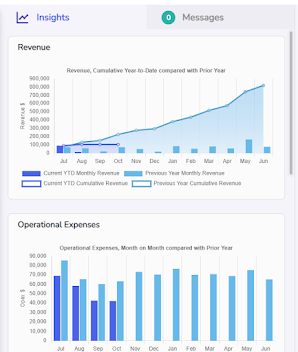
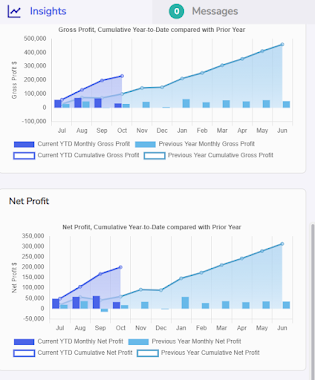
As well as a rundown of items to be looked at. And an “Alexa/Siri” style ‘ask me’ facility to look over various items in the reports. Or to find out more information. And a portal to “ask me anything” as well. Would this be useful to you? Would it help to focus on particular areas that we need to discuss – and take action on? It is a web and app-based system called Aider, which I have been looking at as a ‘Dashboard’ system to help me look over client data. Many features have already been added, and more will come as they continue to develop the system. (Which I am involved in the review of currently) This system can also capture information from other sources – like your social media marketing, point of sale systems, banking, and calendar systems- to be a quick ‘one stop’ for your information. It can connect up to 16 apps, has lots of social media analytics, and provide easy-to-digest information for you 24/7.
The idea, of course, is to focus on the key parameters. If you like, the ‘oxygen pipe’ allows your business to breathe and not leak cash, clients, activity, etc.
- What have I invoiced for the last week/month?
- What bills do I need to pay in the next week/month? What are my tax liabilities? DO I need to pay any super?
- What jobs need completing? What projects need to be started/completed/invoiced?
- Am I on track? Are my sales/expenses/cash at the bank at the level I expected for the year?
- Is my system helping me or hindering me from keeping my finger on the pulse? What can I do about it to improve?I believe that this system can help us get to these key elements quickly and easily – as well as helping us here to keep an eye on your accounts to see if we can help you with anything in your files.
I will be rolling this out with a number of our clients and look forward to discussing the details further with you as part of our work with you. Give me a call, and let’s see how this system can help you keep your oxygen pipe stay secure, unblocked and flowing free!

As for my fish – They are housed in a new tank (as further checks and tests found more than one problem that I had to deal with!) and living happily again.

Even Jasper approves of the new facilities.

And the office set-up is better than before – ready to accommodate face-to-face appointments soon!
For more information on Aider, go to www.aider.ai, or call me to discuss.
And a great Youtube site on keeping fish that I can highly recommend is “Lazarus the Fish Boy”